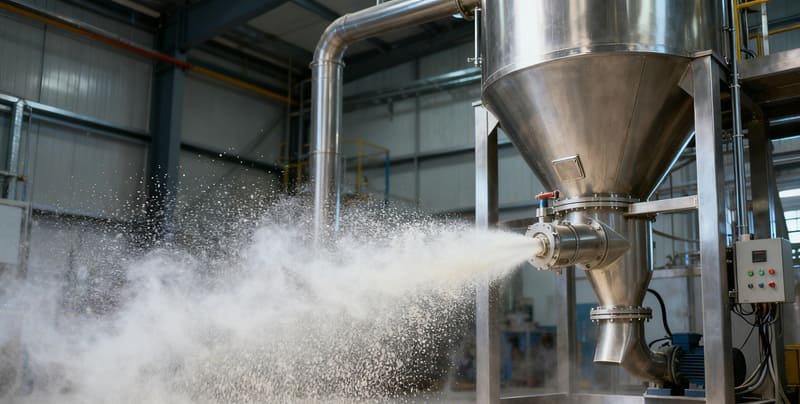
Understanding the Influence of Atomization Pressure on Granule Size Distribution in Industrial Spray Drying
In industrial spray drying used for advanced ceramics, atomization pressure plays a central role in converting slurry into uniform granules with predictable behavior during pressing and sintering. The ability to control Granule Size Distribution directly affects powder flowability, compaction density, and final ceramic microstructure. This article provides a comprehensive technical analysis of how atomization pressure affects droplet formation, how these droplets evolve into granules, and how manufacturers can adjust process conditions to achieve stable ceramic powder performance.
En Tecnología avanzada de polvosEstamos especializados en productos en polvo de alta calidad, que garantizan un rendimiento óptimo para aplicaciones industriales y científicas.
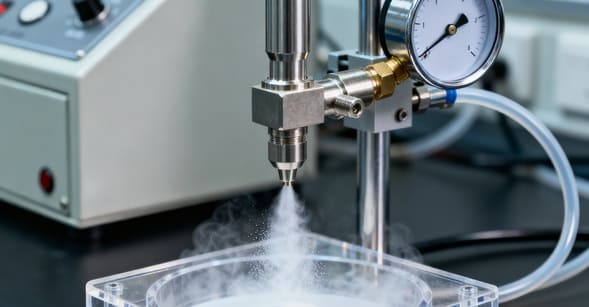
What Is Atomization Pressure in Industrial Spray Drying?
Atomization pressure refers to the applied force that pushes the slurry through a nozzle and breaks it into droplets during spray drying. It controls the initial droplet size, which later determines the final granule size after drying. In ceramic manufacturing, pressure selection must consider slurry characteristics, nozzle design, and required granule performance, making it a foundational parameter in Granule Size Distribution control.
Typical Atomization Pressure Parameters for Industrial Use
| Spray Dryer Type | Atomization Pressure Range | Características |
| Two-fluid nozzle | 1–8 bar | Sensitive to gas–liquid ratio |
| High-pressure nozzle | 20–250 bar | Produces fine, uniform droplets |
| Rotary atomizer | Not pressure-driven | Adjusted by disc speed |
These pressure ranges help manufacturers understand what operational window is suitable for their material system and desired granule size.
Choosing the right atomization pressure ensures predictable droplet breakup and a controlled Granule Size Distribution. By establishing the proper operating regime, ceramic producers achieve more stable powder characteristics and higher-quality products downstream.
How Does Atomization Pressure Directly Affect Granule Size Distribution in Spray Drying?
Atomization pressure determines the breakup energy applied to the slurry. Higher pressure produces smaller droplets, leading to fine and narrow size distributions, while lower pressure generates larger droplets that broaden the Granule Size Distribution. This relationship is critical for achieving consistent ceramic granulation.
Direct Effects of Pressure on Size Distribution
- Higher atomization pressure → Smaller droplets
- Higher atomization pressure → Narrower Granule Size Distribution
- Lower atomization pressure → Larger droplets
- Lower atomization pressure → Broader size distribution
Understanding this relationship helps engineers set pressure levels according to target granule specifications for pressing and sintering.
Ultimately, controlling pressure leads to reproducible granule morphology that improves die filling, reduces segregation, and supports uniform mechanical strength in the final ceramic body.
Descubra nuestra alta calidad polvo productos.
What Physical Mechanisms Link Atomization Pressure to Droplet Breakup?
Droplet formation results from the interaction of inertial forces, viscous forces, and surface tension. Atomization pressure modifies these forces and determines how efficiently the slurry jet breaks into droplets. Higher pressures increase turbulence and enhance breakup, whereas lower pressures reduce disruptive forces, allowing larger droplets to form.
Mechanistic Influence of Pressure on Droplet Breakup
| Mechanism | High Pressure | Low Pressure |
| Inertial force | Dominant | Reduced |
| Surface tension | Quickly overcome | More stable |
| Turbulence | Fuerte | Limited |
| Viscous resistance | Less influential | More influential |
These mechanisms illustrate why high-pressure systems are used when fine granules and narrow distributions are required in technical ceramics.
Understanding the physics behind droplet breakup allows manufacturers to manipulate pressure settings more effectively, ensuring granule structures that meet engineering requirements.
Why Does Granule Size Distribution Matter in Ceramic Powder Performance?
Granule Size Distribution is directly tied to powder behavior during storage, transport, and forming. A narrow distribution promotes uniform packing, predictable compaction, and consistent sintering, whereas a broad distribution can lead to density gradients and internal defects.
Performance Areas Affected by Granule Size Distribution
- Powder flowability during die filling
- Density uniformity in green bodies
- Shrinkage behavior during sintering
- Cracking, warping, or lamination risk
These dependencies show why ceramic manufacturers prioritize granule size stability when optimizing spray drying operations.
Controlling distribution reduces variability and enhances mechanical reliability, especially in applications requiring precise tolerance control such as advanced structural ceramics and electronic substrates.
How Does Spray Drying Behavior Change Under Different Atomization Pressures?
Spray drying performance shifts significantly when the atomization pressure changes. Larger droplets formed at low pressure dry slowly and may develop internal voids, while high pressure produces smaller droplets that dry more uniformly and form denser granules.
Spray Drying Behavior at Low vs. High Pressure
| Parámetro | Low Pressure | High Pressure |
| Droplet size | Large | Small |
| Drying rate | Slow | Fast |
| Granule internal structure | Hollow-prone | Dense |
| Moisture distribution | Uneven | Uniform |
These distinctions are essential when designing ceramic powders for specific forming techniques.
Matching pressure settings to granule requirements ensures higher process stability and reduces powder-related defects throughout manufacturing.
What Other Processing Factors Interact With Atomization Pressure in Spray Drying?
Atomization pressure does not act alone; it interacts with slurry rheology, solid loading, binder content, nozzle geometry, and drying temperature. These variables influence how pressure translates into droplet formation and final granule characteristics.
Factors Interacting With Atomization Pressure
- Slurry viscosity
- Solid loading
- Binder concentration
- Nozzle type and orifice geometry
- Inlet/outlet temperature profiles
Each factor modifies the breakup behavior and can amplify or reduce the effect of atomization pressure.
Managing these interactions holistically allows manufacturers to fine-tune Granule Size Distribution with greater accuracy and consistency.
How Can Manufacturers Optimize Atomization Pressure for Target Granule Size Distribution?
Optimization requires aligning pressure with target granule size ranges, slurry characteristics, and final forming requirements. Particle size analyzers and rheological measurements provide essential data for evaluating pressure-performance relationships.
Pressure Optimization Guidelines
| Target Granule Type | Suggested Pressure Strategy | Beneficios |
| Fine granules (<60 μm) | Higher pressure | Enhanced packing uniformity |
| Medium (60–150 μm) | Moderate pressure | Balanced flow and compactability |
| Coarse (>150 μm) | Lower pressure | Reduced fines formation |
Using these guidelines, manufacturers can produce granules that match the flow, density, and structural requirements of specific ceramic parts.
This optimization approach ensures consistent granulation results, fewer defects, and improved downstream forming and sintering performance.
How Does Controlling Granule Size Distribution in Spray Drying Compare to Other Granulation Methods?
Spray drying competes with alternative methods, including fluidized bed granulation, pan granulation, and freeze granulation. Each method has strengths, but spray drying remains the most efficient for achieving consistent Granule Size Distribution in technical ceramics.
Comparison of Granulation Methods
| Method | Size Distribution Control | Industrial Application |
| Spray drying | Excelente | Technical ceramics |
| Pan granulation | Moderado | Large particle production |
| Fluidized bed | Bien | Pharmaceuticals and chemicals |
| Freeze granulation | Excellent but costly | Research-grade ceramics |
Spray drying’s consistent droplet formation gives it an advantage in high-performance ceramic powder engineering.
This comparison highlights why pressure-controlled spray drying remains the preferred approach in industries demanding tight quality control.
Solicite un presupuesto personalizado para nuestros productos en polvo.
What Future Developments Will Improve Pressure Control and Granule Size Stability?
Emerging technology aims to make atomization pressure control more intelligent and reliable. Trends include AI-enhanced optimization, automated feedback loops, and next-generation nozzle designs that minimize clogging and allow more precise droplet formation.
Future Trends in Spray Drying Technology
- Real-time pressure and droplet monitoring
- Machine-learning optimization algorithms
- Smart nozzles with adaptive orifices
- Energy-efficient spray drying chambers
These developments will help ceramic producers reduce granule variability and achieve unprecedented consistency in powder engineering.
As automation improves, manufacturers can expect tighter control, reduced waste, and better repeatability across production batches.
PREGUNTAS FRECUENTES
| Pregunta | Respuesta |
| How does pressure affect droplet size? | Higher pressure creates smaller droplets and narrower distributions. |
| Can the slurry viscosity change require pressure? | Yes, higher viscosity requires more pressure to achieve fine droplets. |
| Why is granule size stability important? | It affects flowability, density uniformity, and sintering behavior. |
| Is spray drying better than freeze granulation? | For industrial scale, spray drying offers a better cost-performance balance. |
Conclusión
Atomization pressure plays a critical role in shaping Granule Size Distribution during industrial spray drying. By influencing droplet breakup and drying behavior, pressure determines granule morphology and ultimately affects ceramic powder performance in forming and sintering. Understanding how pressure interacts with slurry properties and nozzle design allows manufacturers to fine-tune processes for maximum stability and efficiency. As spray drying technology evolves toward smarter and more responsive systems, the ability to control atomization pressure will become even more precise, supporting advanced manufacturing needs across the ceramic industry.
¿Busca un producto en polvo de alta calidad? Póngase en contacto con nosotros