How to Achieve Spherical Granules in Spray Drying – Key Process and Material Factors
Producing highly spherical granules through spray drying is essential for ceramic manufacturers seeking uniform flow behavior, predictable packing density, and consistent sintering performance. Spherical granules minimize segregation, ensuring the powders behave reliably during pressing and forming. However, achieving near-perfect sphericity is not a simple outcome of atomization alone. It depends on a coordinated balance of slurry formulation, droplet formation, drying rate, and particle-solidification dynamics.
This article examines the mechanisms that control spherical granule formation and breaks down the primary processes and material parameters that influence their morphology. Drawing from industrial data and ceramic engineering principles, the following sections provide an in-depth and actionable framework for optimizing spray drying to achieve high-quality spherical granules.
Au Technologie avancée des poudresNous sommes spécialisés dans les produits en poudre de haute qualité, garantissant des performances optimales pour les applications industrielles et scientifiques.
What Does “Spherical Granules” Mean in Spray Drying and Why Is Sphericity Important?
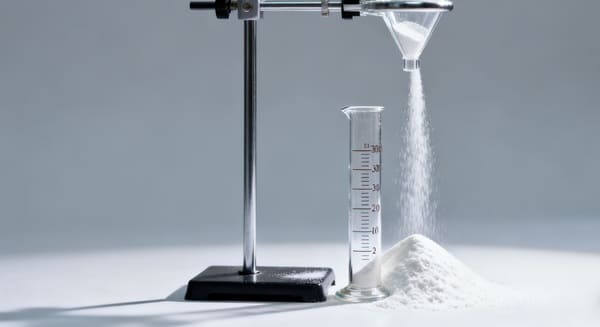
Understanding what qualifies as a spherical granule is the foundation for discussing process optimization. In ceramic spray drying, a spherical granule is one whose shape approaches an ideal round profile while maintaining uniform internal moisture and a stable outer shell. These attributes directly affect flowability, die-filling uniformity, and green-body density distribution, all of which influence dimensional accuracy and sintered strength.
Typical Metrics Used to Evaluate Spherical Granules
| Metric | Industry Reference Range | Impact on Production |
| Roundness Index | 0.85–0.95 | Lower friction during die filling |
| Aspect Ratio | 1.00–1.10 | Predictable compaction behavior |
| Surface Roughness (Ra) | 2–5 μm | Affects binder distribution |
| Internal Moisture Gradient | < 1% variance | Prevents capping and lamination |
Achieving these targets improves granule mobility and reduces defect rates during compaction. Spherical granules also pack in a more predictable geometric pattern, leading to fewer density gradients within the final ceramic body. For high-precision applications such as technical ceramics, this directly translates to repeatable performance and lower production scrap rates.
Découvrez nos produits de haute qualité poudre produits.
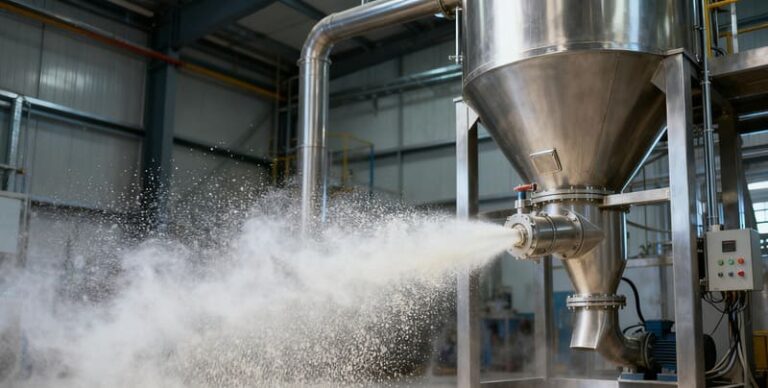
How Does Spray Drying Work When Producing Spherical Granules?
To understand how sphericity develops, we must examine the fundamental mechanisms of spray drying:
- Slurry atomization into fine droplets
- Rapid heat transfer causes solvent evaporation
- Shell formation around the droplet
- Final solidification into a stable granule
Each stage influences the granule’s ability to maintain a round shape. A stable surface tension boundary is required to keep droplets spherical during early evaporation, while controlled moisture removal prevents deformation or collapse during shell formation. The goal is to maintain uniform shrinkage so that the droplet solidifies symmetrically.
Key Stages in Spherical Granule Formation
| Stage | Critical Parameter | Effect on Sphericity |
| Atomization | Droplet size uniformity | Determines starting geometry |
| Early drying | Surface tension forces | Maintains spherical shape |
| Shell formation | Evaporation rate | Prevents wrinkling or collapse |
| Late drying | Internal moisture movement | Prevents dimples or irregular surfaces |
Optimizing these stages ensures that droplets retain their spherical geometry throughout the transformation from liquid to solid. Most defects originate when heat, moisture, or mechanical forces act unevenly on the droplet.
What Slurry Properties Influence the Formation of Spherical Granules?
Slurry formulation is one of the strongest predictors of granule shape. Viscosity, binder type, particle-size distribution, and solid loading all affect droplet stability. If the slurry is too thin, droplets may collapse or wrinkle; if too thick, they may form irregular shells. A well-balanced formulation stabilizes the droplet surface and ensures even drying from the outer layer inward.
Slurry Parameters Affecting Granule Sphericity
| Paramètres | Gamme typique | Influence on Granules |
| Solid Content | 60–75 wt% | Higher content → smoother spheres |
| Slurry Viscosity | 150–800 mPa·s | Prevents droplet deformation |
| Binder Content | 1–5 wt% | Improves shell elasticity |
| Particle Size (d50) | 0.5–3 μm | Affects droplet shrinkage uniformity |
When these parameters are balanced, droplets maintain shape integrity during the critical transition from liquid to semi-solid. A mismatch—such as high solid content with low binder—can cause cracking, dimpling, or asymmetric granule formation.
How Do Atomization Parameters Affect Spherical Granule Formation?
Atomization defines the initial geometry of droplets. Achieving a narrow droplet-size distribution is the foundation of achieving uniform sphericity. Both nozzle type and pressure determine how droplets break apart and how uniformly they form in the drying chamber.
Atomization Parameters and Expected Outcomes
| Paramètres | Recommended Setting | Effect on Sphericity |
| Atomization Pressure | 70–160 bar | Controls droplet uniformity |
| Nozzle Type | Two-fluid or pressure nozzle | Affects droplet structure |
| Orifice Size | 0.7–1.2 mm | Smaller orifice → smoother droplets |
| Spray Angle | 60–90° | Determines drying path consistency |
Proper atomization ensures droplets start with smooth surfaces and predictable geometry. Irregular atomization increases granule defects such as elongated shapes, hollow spots, or rough surfaces. Stable pressure delivery and routine nozzle inspection are essential for consistent spherical granules.
How Do Drying Conditions Determine Final Sphericity of Spray-Dried Granules?
Drying profiles strongly influence the shell formation process. If the outer layer solidifies too fast, it forms a rigid crust that traps moisture inside. This trapped moisture pushes outwards during later evaporation, causing dimples or buckling. Conversely, too slow drying leads to wrinkling and irregular shrinkage.
Critical Drying Conditions for Sphericity
| Condition | Target Range | Impact on Shape |
| Inlet Temperature | 170–220°C | Controls initial shell formation |
| Outlet Temperature | 80–110°C | Ensures gradual moisture release |
| Drying Time | 5–20 s | Too fast → crusting; too slow → deformation |
| Airflow Pattern | Cyclonic/consistent | Promotes symmetrical drying |
Achieving spherical granules requires not only correct temperatures but also maintaining a stable drying environment. Turbulent air patterns or inconsistent heat distribution can distort soft droplets before they harden.
Why Do Binder and Additive Systems Influence Spherical Granule Quality?
Binders improve structural cohesion during droplet drying and prevent cracking or fragmentation during shell formation. Plasticizers, dispersants, and surfactants also play roles in stabilizing the droplet surface and ensuring uniform shrinkage.
Common Additives and Their Effects
| Additive Type | Function | Influence on Sphericity |
| Binders (PVA, PEG) | Improve elasticity | Prevent cracking |
| Surfactants | Reduce surface tension | Enhance droplet roundness |
| Plasticizers | Improve flexibility | Reduce surface wrinkling |
| Dispersants | Improve particle packing | Stabilize shrinkage |
Well-designed additive systems help droplets remain stable as moisture escapes, minimizing structural collapse. Without these additives, the spherical form is harder to maintain, especially for fine ceramic powders.
How Do Different Ceramic Materials Respond in Spherical Granule Formation?
Material characteristics—such as particle shape, surface area, and hygroscopicity—affect drying behavior. Different ceramic systems require different slurry and drying strategies to achieve spherical granules.
Comparison of Materials in Spray Drying
| Matériau | Behavior During Drying | Impact on Sphericity |
| Alumina | High thermal stability | Forms consistent spheres |
| Zirconia | Dense particles | Needs higher binder content |
| Silicon Nitride | Hygroscopic | Requires controlled drying |
| Mullite | Irregular particle geometry | Needs surfactant support |
Matching formulation and process conditions to material properties ensures consistent outcomes. Materials with irregular particle shapes or high moisture affinity require additional process adjustments to achieve spherical granules.
Request a custom quote for our powder products.
How Does Sphericity in Spray-Dried Granules Compare with Other Granulation Methods?
Spray drying is favored for producing spherical granules, but it is not the only granulation method. Techniques such as high-shear granulation or disc granulation usually produce granules with lower roundness due to mechanical shaping rather than liquid droplet formation.
Comparison of Granulation Methods
| Method | Typical Shape | Level of Sphericity |
| Spray Drying | Near-spherical | Haut |
| High-Shear Granulation | Irregular/rounded | Moyen |
| Disc/Pan Granulation | Lenticular | Faible |
| Fluidized Bed Granulation | Moderately spherical | Moyen |
Spray drying stands out for producing granules with superior roundness and uniformity. For applications requiring tight specifications, it remains the most effective technique.
What Are the Future Trends for Achieving Spherical Spray-Dried Granules?
Emerging trends include machine-learning optimization, real-time droplet imaging, and new binder systems designed for controlled shrinkage. Continuous monitoring technologies help maintain sphericity consistency and reduce off-spec production.
Key Trends Shaping the Future
| Tendance | Description |
| Inline particle-shape monitoring | Detects shape deviations in real time |
| AI-based process optimization | Predicts ideal parameters |
| Novel binders | Improve drying flexibility |
| Energy-efficient dryers | Reduce thermal stress on droplets |
These advancements will allow ceramic manufacturers to maintain tighter control over granule properties, pushing the industry closer to zero-defect powder preparation.
FAQ
| Question | Réponse |
| Why are spherical granules important? | They improve flowability, packing uniformity, and sintering performance. |
| Which parameter influences sphericity the most? | Slurry formulation and atomization uniformity dominate overall shape. |
| What causes rough surfaces? | Uneven drying, low binder content, or oversized particles. |
| How to prevent dimpling? | Use controlled drying profiles and sufficient binder. |
| What is the ideal roundness index? | Industry targets typically range from 0.85 to 0.95. |
Conclusion
Achieving highly spherical granules in spray drying is the result of coordinated control over slurry formulation, droplet generation, drying dynamics, and material behavior. By optimizing atomization conditions, adjusting binder systems, and aligning drying profiles with the physical characteristics of ceramic powders, manufacturers can consistently produce granules with excellent flowability and compaction behavior. As new technologies advance real-time monitoring and predictive control, achieving perfect spherical granules will become increasingly precise and reliable in modern ceramic manufacturing.
Looking for high-quality powder products? Contactez-nous dès aujourd'hui !